



As the software industry enters 2025, testing teams worldwide are experiencing one of the most significant shifts in their history. The undeniable rise of AI, the acceleration of DevOps maturity, and the redefinition of the tester role have collectively reshaped the foundations of software quality.
This report synthesizes insights from hundreds of technical interviews, a seven-year longitudinal automation survey (2018–2025), and observations from thousands of engineering professionals. The patterns emerging from this data provide a clear preview of what quality engineering looks like in 2025.
The patterns emerging from this data provide a clear preview of what quality engineering will look like in 2026 and what organizations must adopt to maintain competitive velocity, reliability, and customer trust.
What follows is a comprehensive, forward-looking analysis of the top automation testing trends for 2025 & 2026, written for leaders who want to improve productivity, reduce release risk, and future-proof their QA strategy.
| TABLE OF CONTENTS |
| Agentic AI: The New Foundation of Test Automation |
| Example: How Agentic AI Executes an Autonomous Workflow |
| AI Shift-Right: Scaling Quality by Understanding Real Users |
| Moonshot Vision 2025: AI-Native Testing Ecosystems |
| Everyone Is QA: Human-in-the-Loop Quality |
| Evolution of the Tester Role in an AI-First Era |
| DevOps + SRE Convergence: From Continuous Delivery to Continuous Quality |
| Rise of End-to-End (E2E) Autonomous Quality Platforms |
| Playwright Becomes the Automation Front-Runner |
| The Must-Learn Language for Testers in 2025 |
| How to Succeed with Automation Testing in 2025 |
2025 marks the arrival of Agentic AI as a core component of modern software testing. While 2023–2024 saw teams experimenting with AI-assisted authoring and test optimization, 2025 is the first year where AI-driven autonomy moves from experimental to operational.
Industry Data: AI Adoption Has Entered Hyper-Growth
Across our long-term survey (2018–2025), QA teams reported a profound acceleration in AI adoption:
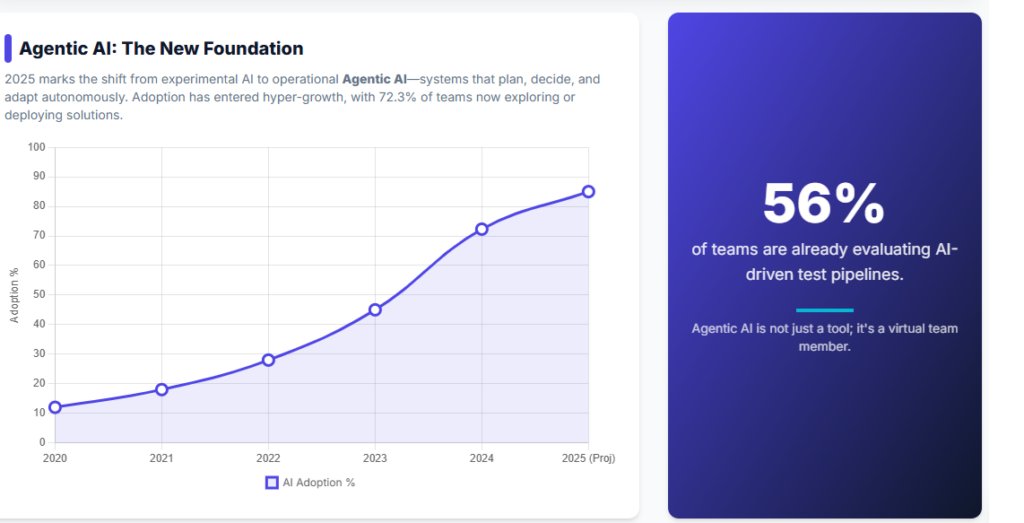
AI Adoption Curve (2020–2025)
Imagine a line graph where the curve is flat from 2020 to 2022, then gradually rises in 2023, and accelerates sharply during 2024–2025, reflecting decisive industry adoption.
Traditional AI-powered testing required human oversight at every major step.
Agentic AI is the opposite — it plans, decides, interacts, and adapts independently.
An Agentic AI system within QA can:
In practical terms, it operates like a virtual QA engineer capable of making strategic decisions — not just automating scripts.
To understand the real impact, imagine an e-commerce company running a massive regression suite.
Instead of a human-driven test cycle, an Agentic AI handles the entire process:
The AI examines:
The agent then prioritizes regression tests based on probability of impact.
Instead of executing the entire regression suite, the agent automatically chooses:
This reduces test execution time dramatically.
The agent:
After execution, the agent:
With every cycle, the agent improves its:
This is not futuristic — this is the direction top engineering organizations are already moving toward in 2025.
Based on industry polling:
In short:
Agentic AI will be the most transformative automation trend of 2025.
Shift-left testing transformed early-cycle quality.
But 2025 is the year Shift-Right testing becomes strategic, not optional.
Modern applications now serve global audiences, generate continuous behavioral data, and operate in unpredictable real-world conditions. Testing can no longer be limited to pre-release validation; it must account for how users actually behave after deployment.
AI is enabling this shift by giving QA teams the ability to analyze:
Our longitudinal survey shows rapidly growing interest in:
These practices help teams reduce user-reported bugs and focus their testing investment on workflows that directly affect customer satisfaction.
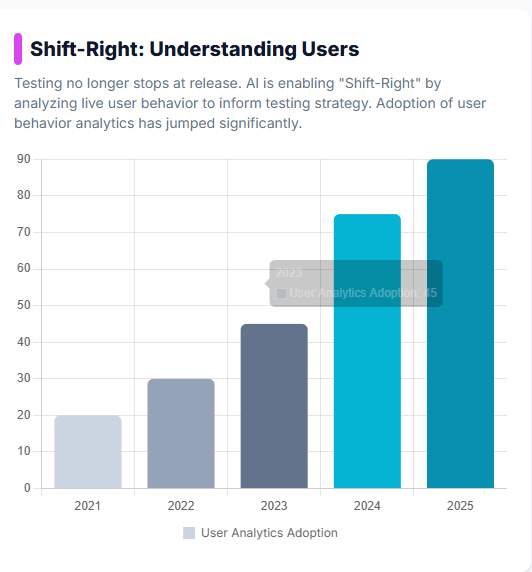
User Behavior Analytics Adoption (2021–2025)
A bar graph steadily rises year-over-year, with a notable jump in 2024–2025 as AI-powered tools become widely available.
AI helps identify:
Gojko Adzic has long emphasized the importance of capturing real-world experience analytics — 2025 is finally the year where tooling catches up with that vision.
Organizations adopting AI-driven Shift-Right report:
Shift-Right does not replace pre-release testing — it enhances it by providing true operational insight.
Looking ahead, 2025 signals the emergence of an entirely new class of tools:
AI-native quality platforms built around real user behavior, autonomous learning, and zero-maintenance testing.
Early prototypes (such as next-generation AI QA tools in beta across the industry) show what’s coming next.
Instead of relying on brittle selectors, AI captures the actual visual and contextual state of a user session, making tests far more stable.
AI identifies:
— all directly from live telemetry.
AI continuously adjusts tests based on:
This eliminates the largest hidden cost of automation: maintenance debt.
AI analyzes:
and feeds that information back into pre-release regression suites.
AI identifies:
It can even recommend precise fixes.
AI monitors:
This makes testing proactive rather than reactive.
This future — now emerging — represents a fundamental shift:
Testing is no longer something we write.
It’s something the system learns, generates, and improves autonomously.
2025 is not the year testing becomes “AI only.”
It’s the year quality becomes everyone’s responsibility, guided by AI.
Testing historically sat in a silo.
But AI and low-code tooling are dissolving the walls between:
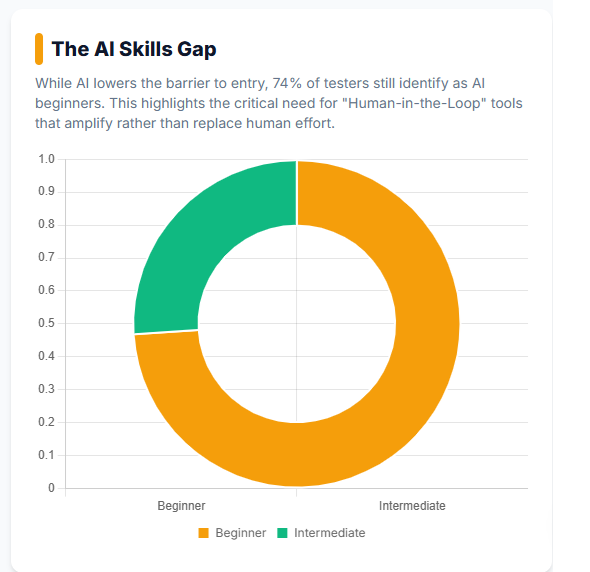
AI Skill Levels Among Testers (2025)
A pie chart showing:
Human-in-the-Loop: Why Humans Still Matter
As Tobias Müller famously said:
“It’s not about trusting AI. It’s about trusting the guardrails you set.”
AI can execute, optimize, predict, and detect — but it still needs:
Teams that blend AI autonomy with human oversight consistently outperform those using AI only for isolated tasks.
Testing roles are changing faster than ever.
A modern tester in 2025 is expected to be:
Based on multi-year survey responses:
The New Hybrid Tester Must:
2025 is not just a year of new tools — it’s a year of new expectations for how testers contribute to the engineering ecosystem.
If the last decade was about shifting-left, 2025 is the year testing fully embeds itself into DevOps and Site Reliability Engineering (SRE) ecosystems.
Quality is no longer a gate — it’s a continuous operational discipline.
DevOps Adoption Is Accelerating
Across the data collected between 2018–2025, a major milestone stands out:
This shows a clear shift: testing is consolidating into the broader engineering pipeline.
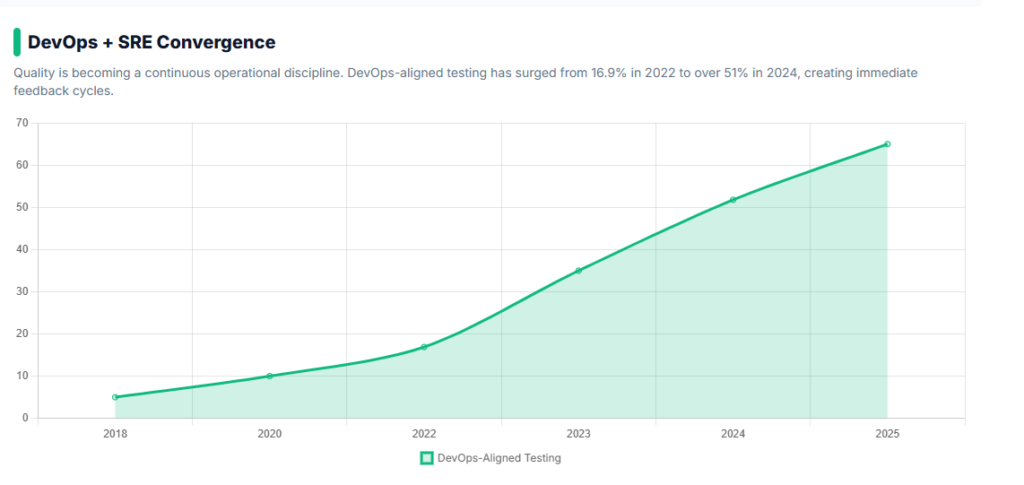
DevOps Integration Growth (2018–2025)
A multi-year line graph starts low in 2018, dips slightly in 2020–2021, then rises sharply after 2022 and peaks in 2025, illustrating mainstream adoption of DevOps-driven testing.
Testing is executed:
This reduces the time to detect defects and significantly lowers production risk.
SRE-driven insights help QA teams:
Testing moves from reactive validation to proactive prevention.
Developers, QA engineers, SREs, and platform teams are increasingly sharing:
This blurs the traditional boundaries between roles and creates shared ownership for reliability.
2025 DevOps organizations automate:
Testing becomes a pipeline-driven, system-level capability.
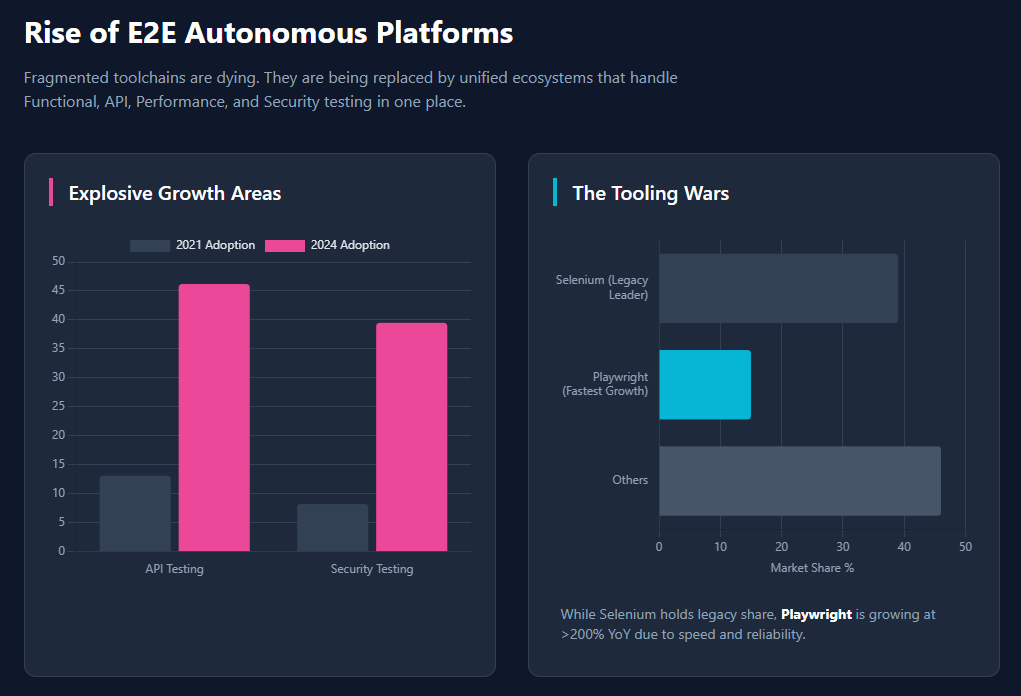
The rise of E2E Quality Platforms marks one of the most transformative testing shifts in 2025.
These platforms unify:
all within one AI-driven ecosystem.
Survey responses show explosive growth across key areas:
Testing Trends 2018–2025 (AI/ML, API, Security, DevOps)
A multi-line chart shows AI/ML growing steadily, API testing spiking sharply in 2024, and security and DevOps trending upward across several years.
Instead of dozens of disconnected tools, teams get a single orchestrated platform.
AI performs:
with minimal human overhead.
E2E platforms incorporate:
This closes the loop between pre-release and post-release quality.
Enterprises eliminate redundant tools, simplifying governance and reducing cost.
Playwright has emerged as one of the fastest‑growing automation tools, and many modern teams are adopting it as a primary choice for web test automation in 2025. Community and industry reports indicate that while Selenium still retains the largest share of the overall automation market, Playwright’s adoption has grown rapidly into the mid‑teens percentage-wise and continues to climb year over year.
Recent data points show, for example, Selenium with around 39% test automation market share and Playwright with about 15% but experiencing over 200% year‑over‑year growth and millions of weekly downloads. These numbers highlight Playwright’s strong trajectory even though it has not yet surpassed Selenium in overall market share.
Why Playwright is pulling ahead in new projects
Tool selection, however, is never one‑size‑fits‑all; it must align with application complexity, team skills, legacy systems, integrations, and business constraints. Playwright’s growth is significant and worth attention, but Selenium, Cypress, and other frameworks remain relevant in many organizations.
Python is one of the most important languages for testers to learn in 2025… indexes place Python at or near the top
According to the TIOBE index, Python remains the:
language in the world.
Simplicity
Quick to learn, readable, and beginner-friendly.
AI & Machine Learning
Most AI frameworks (TensorFlow, PyTorch, scikit-learn) are Python-native — essential for working with AI-driven testing tools.
Python integrates seamlessly with:
As testers evolve into AI-augmented quality engineers, Python becomes the universal “bridge language.”
2025 is not just a year of new trends — it’s a year demanding decisive action.
Here is the expert-backed strategy for thriving in this new testing era.
Begin integrating AI-driven decision-making into:
Even gradual adoption will dramatically increase test velocity.
Use production data to:
Invest in:
Hybrid testers = future testers.
For faster, more resilient software delivery:
Choose tools that:
2025 is the beginning of a fundamental shift: AI doesn’t replace the tester , it amplifies the tester.
Organizations that embrace Agentic AI, integrate with DevOps and SRE, and empower teams with modern tools will:
The testing teams that evolve now will define the next decade of software quality.
Author: admin | Posted On: 17th December 2025 | Category: Article
© 2024 Novature Tech Pvt Ltd. All Rights Reserved.

